Mastering Forex with Elliott Wave Theory: An Advanced Guide
Delve into Elliott Wave Theory for forex. Master wave patterns to elevate your trading strategy.

What if you could predict market movements with precision? Imagine having a roadmap that guides you through the chaos of the forex market, anticipating turns before they occur. Elliott Wave Theory offers such insight, unveiling the repetitive patterns hidden within price movements.
TL;DR
- Elliott Wave Theory helps forecast market trends by analyzing wave patterns.
- It comprises five-wave impulse sequences and three-wave corrective patterns.
- Utilizing Elliott Wave can enhance your forex trading strategy.
- Understanding wave degrees and cycles is crucial for accurate analysis.
- Incorporate risk management to safeguard against unexpected market shifts.
Understanding Elliott Wave Theory
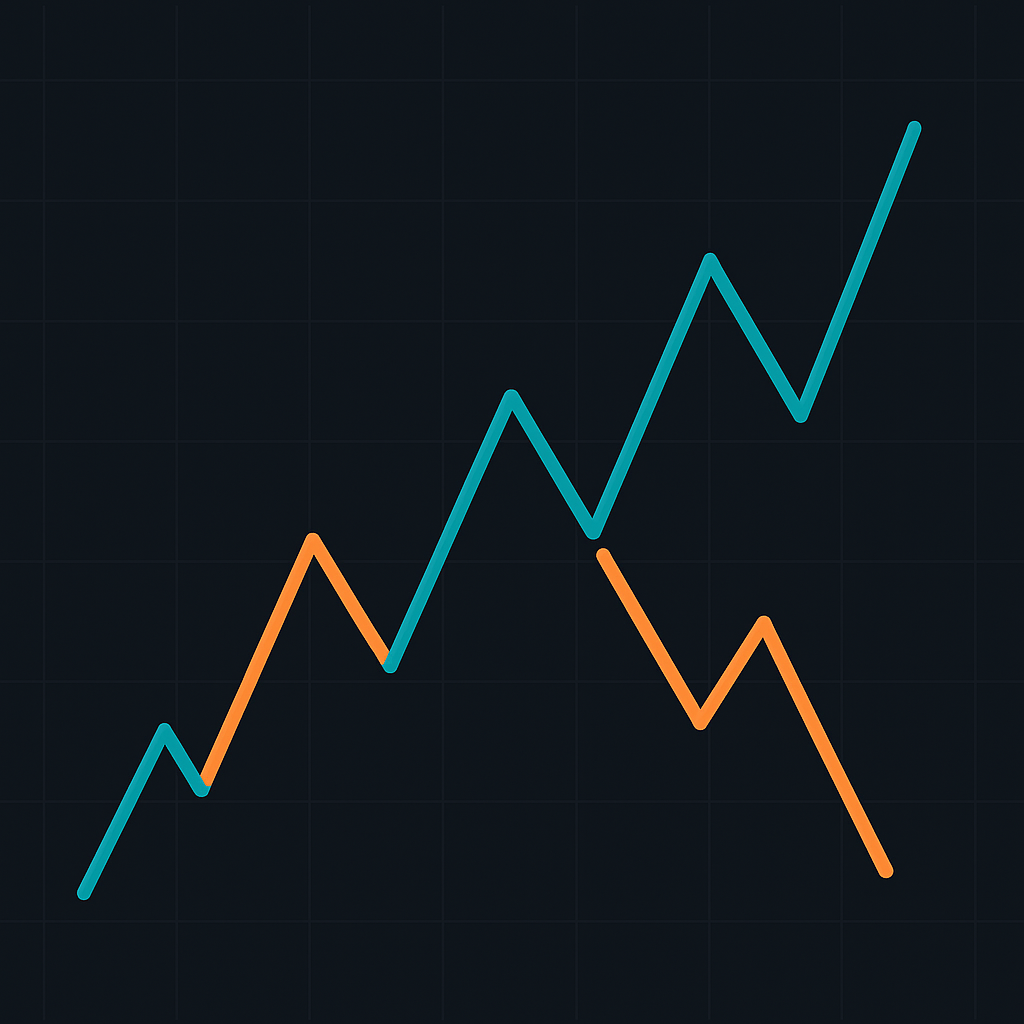
Elliott Wave Theory, developed by Ralph Nelson Elliott in the 1930s, is a form of technical analysis that traders use to forecast future market movements by identifying recurring wave patterns. At its core, it posits that market prices unfold in specific patterns, or waves, influenced by the collective psychology of market participants.
The Basic Structure of Waves
The theory is built on two types of waves: impulse waves, which move in the direction of the market trend, and corrective waves, which move against it. A complete Elliott wave cycle consists of eight waves: five impulse waves followed by three corrective waves.
Identifying Impulse Waves
Impulse waves are the main drivers of market trends. They consist of five distinct waves: three in the direction of the trend (waves 1, 3, and 5) and two corrective waves (2 and 4). Understanding these waves can help traders enter and exit positions more effectively.
Characteristics of Impulse Waves
- Wave 1: Often difficult to identify during real-time trading as it marks the start of a new trend.
- Wave 3: Typically the longest and strongest wave, offering significant trading opportunities.
- Wave 5: Often marked by investor euphoria and can signal the end of the trend.
The Role of Corrective Waves

Corrective waves are essential for understanding market retracements. These three-wave patterns, labeled as A, B, and C, move against the prevailing trend and are crucial for identifying potential reversal points.
Types of Corrective Waves
Corrective waves can form in various patterns, including zigzags, flats, and triangles. Each pattern offers unique insights into the market’s corrective phase.
Applying Elliott Wave Theory in Forex Trading
Integrating Elliott Wave Theory into your forex trading strategy can enhance your ability to predict market movements and improve decision-making. By recognizing wave patterns early, traders can better position themselves for profit.
Step-by-Step Application
- Identify the trend: Determine whether the market is in an impulse or corrective phase.
- Analyze wave patterns: Use historical data to locate waves and predict future movements.
- Enter trades: Align entry points with the beginning of impulse waves for maximized gains.
- Set stop-loss and take-profit levels: Use the 20-50 pip rule for stop-loss and apply a 1:2 or 1:3 risk-reward ratio for take-profit.
Common Challenges and Solutions
While Elliott Wave Theory is powerful, it isn’t without challenges. Misidentifying wave patterns or the wave count can lead to inaccurate forecasts. Continuous practice and experience are key to mastering this technique.
Overcoming Misinterpretations
Utilize additional technical analysis tools, such as Fibonacci retracements, to validate wave counts and improve accuracy.
Practical Examples in Current Market Context
Let’s consider the EUR/USD pair currently trading at 1.0420. If you identify the start of a wave 3 impulse, you might enter a long position, setting a stop-loss 30 pips below at 1.0390 and a take-profit 90 pips above at 1.0510.
Analyzing Other Pairs
For GBP/USD at 1.2520, if an impulse wave is forming, similar strategies can be adapted, considering the pair’s specific volatility and historical patterns.
Integrating Elliott Wave with Other Strategies
Combining Elliott Wave Theory with other technical indicators can provide a more comprehensive view of market conditions. Consider blending it with moving averages or RSI for enhanced signal confirmation.
Creating a Robust Strategy
By integrating diverse tools, traders can build a strategy that accommodates various market scenarios, ensuring flexibility and adaptability.
Comparison with Other Technical Analysis Tools
| Analysis Tool | Strengths | Weaknesses |
|---|---|---|
| Elliott Wave Theory | Predictive power, identifies market cycles | Complex, subjective interpretation |
| Fibonacci Retracement | Identifies support/resistance levels | Static, doesn’t adapt to new data |
| Moving Averages | Simple, highlights trends | Lags, doesn’t predict reversals |
FAQs
- What is the key benefit of using Elliott Wave Theory? It helps in anticipating market movements by identifying wave patterns.
- Can beginners use Elliott Wave Theory effectively? It requires practice and understanding; beginners should start with simpler analysis tools.
- How does Elliott Wave Theory compare to other forex strategies? It offers unique predictive capabilities but is more complex than other methods.
- What are the risks of relying solely on Elliott Wave Theory? Interpretation errors can lead to significant losses; always combine with risk management strategies.
- Is it applicable to all currency pairs? Yes, but effectiveness varies with market conditions and trader expertise.
Risk Disclaimer: Forex trading involves significant risk and may not be suitable for all investors. Leverage creates additional risk and loss exposure. Carefully consider your financial situation and experience level before trading.