Expanding Horizons: Leverage Currency Indexes for Better Forex Analysis
Learn how currency indexes can transform your forex trading strategy with deeper insights.

Expanding Horizons: Using Currency Indexes for Enhanced Forex Analysis
Have you ever felt that your forex analysis toolkit is missing a crucial element? Currency indexes might be the missing piece that can elevate your trading strategy to new heights. By understanding the broader movements of individual currencies, rather than focusing solely on pairs, you can gain deeper insights and make more informed decisions.
TL;DR
- Currency indexes track the strength of individual currencies against a basket of others.
- They provide a broader market perspective, enhancing traditional pair analysis.
- Use currency indexes to spot trends and confirm forex signals.
- Complementary to technical and fundamental analysis.
- Incorporate them into your strategy for more robust trading decisions.
What Are Currency Indexes?
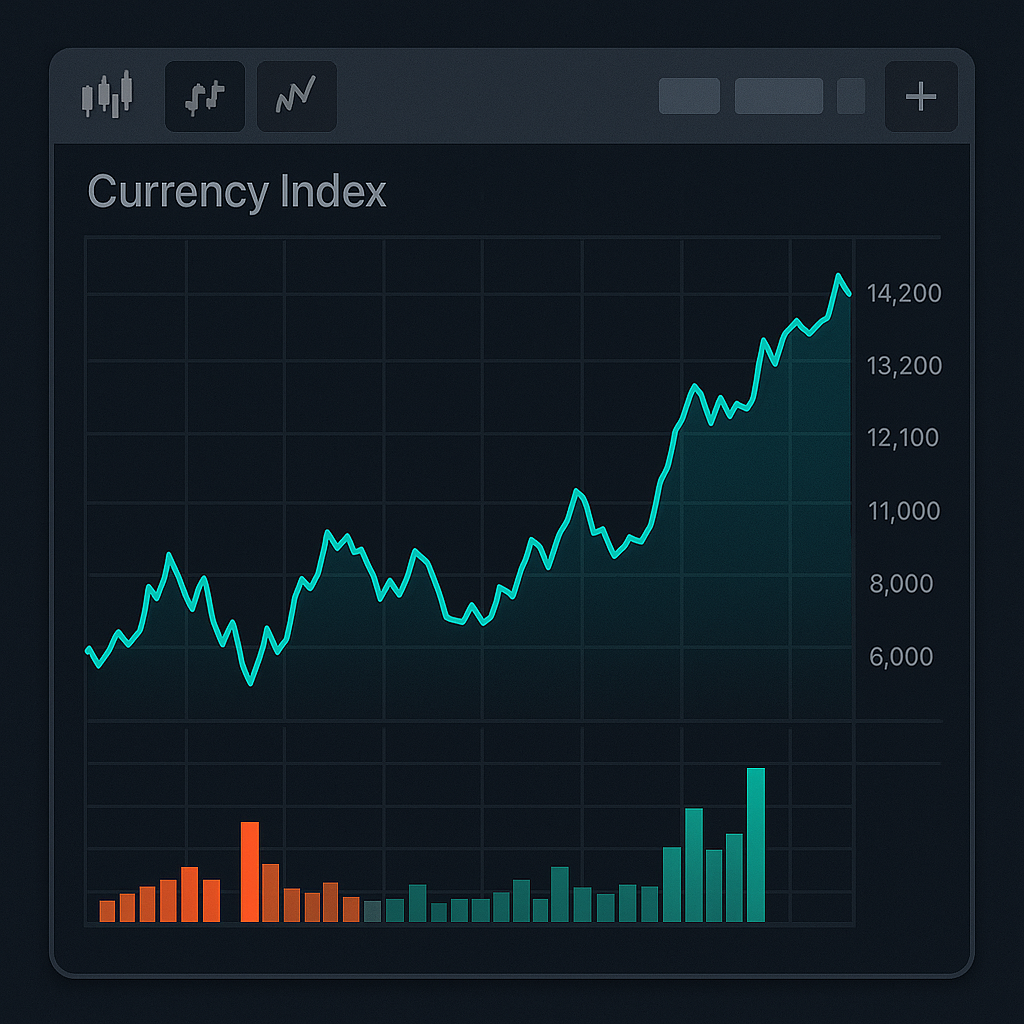
Currency indexes are tools that measure the value of a currency relative to a basket of other currencies. They provide a way to gauge the overall strength or weakness of a currency without focusing on specific pairs. The most well-known currency index is the U.S. Dollar Index (DXY), which tracks the USD against six major currencies, including the euro, yen, and pound.
How Are Currency Indexes Constructed?
Constructing a currency index involves selecting a basket of currencies against which the currency is measured. Each currency in the basket is weighted based on its trade volume and economic significance. For example, in the DXY, the euro holds the highest weight, reflecting the significant trade relationship between the U.S. and the Eurozone.
Why Use Currency Indexes in Forex Analysis?
Many traders rely heavily on analyzing currency pairs alone. However, incorporating currency indexes into your analysis provides a broader perspective, helping to:
- Identify Trends: Spot overarching trends in a currency's strength or weakness.
- Confirm Signals: Use indexes to validate signals from pair-specific strategies.
- Assess Market Sentiment: Gauge overall market sentiment towards a currency.
Practical Applications of Currency Indexes

Trend Spotting
With currency indexes, you can easily determine whether a currency is in a long-term uptrend or downtrend. For instance, if the USD is strengthening across the board, the DXY will likely show a consistent upward trajectory, confirming bullish sentiment.
Signal Confirmation
Integrating Currency Indexes with Traditional Analysis
Currency indexes are not meant to replace traditional analysis but rather complement it. By integrating them with technical and fundamental analysis, you can create a more comprehensive view of the market. For instance, a strong USD index reading could support a bearish forecast for commodities like gold, which is priced in dollars.
Step-by-Step: Using Currency Indexes in Your Strategy
- Select an Index: Choose an index relevant to your trading pairs.
- Analyze the Chart: Look for trends, breakouts, or reversals.
- Cross-Verify: Check forex signals or other analysis methods for confirmation.
- Implement Trades: Use the insights to guide your trade entries and exits.
Comparison: Currency Index vs. Currency Pair Analysis
| Aspect | Currency Index | Currency Pair |
|---|---|---|
| Focus | Broader market strength | Specific pair dynamics |
| Data Source | Multiple currencies | Two currencies |
| Use Case | Trend spotting | Trade execution |
Real-Life Scenarios and Examples
Consider the current market scenario where EUR/USD is trading at 1.0420. If the Euro Index shows a downward trend, it may suggest that the euro is experiencing overall weakness, supporting a bearish outlook for EUR/USD.
Frequently Asked Questions
- What is a currency index used for? Currency indexes are used to measure the strength of a currency against a basket of other currencies, providing a clear picture of its overall market position.
- How can currency indexes improve my trading strategy? By offering a broader market perspective, currency indexes can help confirm signals and identify trends, leading to more informed trading decisions.
- Are currency indexes suitable for all traders? Yes, both beginner and advanced traders can benefit from using currency indexes as part of their analysis toolkit.
- Can currency indexes replace traditional analysis? No, they are most effective when used in conjunction with other analysis methods.
Risk Disclaimer: Forex trading involves significant risk and may not be suitable for all investors. The contents of this article are for informational purposes only and do not constitute financial advice. Always evaluate your risk exposure and trading strategy carefully.